
What’s Next? My Six Predictions for the Next Wave of Bags – Autumn/Winter 26
There is a question I get asked constantly. What’s going to be the next It bag? And increasingly, I think
There is a question I get asked constantly. What’s going to be the next It bag? And increasingly, I think
There are some things in fashion that need absolutely no introduction. From the brilliance of Karl Lagerfeld, we gained the
Why the smallest details can say more about a luxury bag than the biggest logo There are certain things I
More luxury guides coming soon!
A Founder’s Reflection by Tony Hookings-Skinner
There is a phrase I hear increasingly often when people talk about counterfeit designer bags:
“But it’s a really good fake.”
For me, those five words don’t change anything, a fake is a fake. It doesn’t matter whether the stitching is almost perfect, whether the leather feels incredible, whether the hardware has the right weight or whether somebody tells you it came from the same factory, it isn’t the bag it claims to be.
And perhaps unsurprisingly, since founding Élan Archive, I’ve become even more passionate about that distinction.
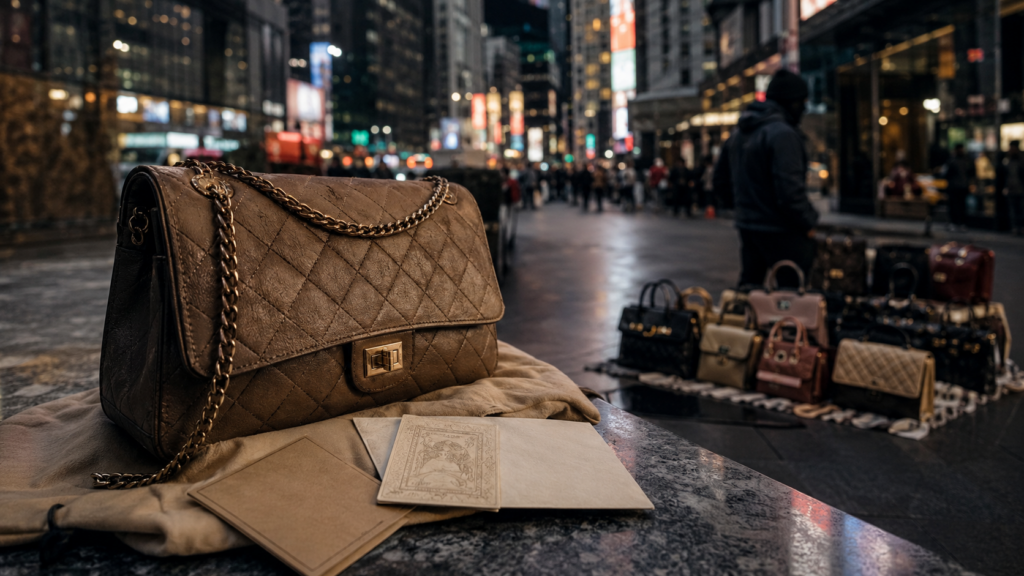
Counterfeit bags are hardly new, Canal Street has been part of the New York shopping landscape for decades. The whispered offers, the hidden rooms, the laminated photographs and the endless copies of whichever Louis Vuitton, Chanel, Dior or Hermès bag happens to be having its moment. There was always something slightly underground about it.
When we were back in New York in May however, what struck me was just how visible it had become, we were seeing vendors openly displaying counterfeit designer bags around Times Square, not tucked away, not particularly disguised, just there.
And seeing them surrounded by some of the world’s most recognisable luxury names made me think about the strange relationship fashion now has with the fake, we’ve almost normalised it. There is the real bag, there is the obvious fake, then there is this increasingly sophisticated world of the superfake, pieces deliberately made to get closer and closer to the original.
But however close they get, there is still one rather fundamental problem, they are not original.
Since launching Élan Archive, I have been contacted by what feels like hundreds of suppliers offering counterfeit goods. Messages arrive constantly, catalogues. photographs. videos. prices with claims about quality and invitations to buy pieces carrying virtually every major luxury house imaginable.
Often from suppliers based in China, although the counterfeit industry is far wider than any one country, the scale has genuinely surprised me, and the numbers tell the same story.
The OECD and EU Intellectual Property Office estimated the global trade in counterfeit goods at $467 billion in 2021 — around 2.3% of total world trade. Clothing, footwear and leather goods remain among the categories most affected, with handbags specifically identified among the products regularly targeted by counterfeiters.
This isn’t a tiny side industry operating on the fringes of fashion, it is enormous, and increasingly sophisticated. Logistics, e-commerce and small-parcel shipping have made it easier for counterfeit goods to enter markets around the world.
For Élan, though, the answer to every one of those supplier approaches has always been incredibly simple, an unequivocal and emphatic…. No.
Because Élan Archive was built on the foundation of beautiful, original pieces, and that word matters to me, Original.
Give me a twenty-year-old genuine bag with a softened handle, a little corner wear and a story over a pristine counterfeit any day of the week. Actually, I think those imperfections can make a bag even more interesting.
A vintage Louis Vuitton that has travelled, a Chanel Classic Flap whose leather has softened beautifully, or an Hermès bag carrying the patina that comes from somebody actually using and loving it. Those things aren’t defects in luxury, they are history and increasingly, I think that is where the magic of preloved lies.
You are buying the work of the original designer and craftspeople. You are buying the materials they selected, the proportions they agonised over, the hardware they developed and the construction techniques they refined. You are buying a piece that has already existed within the story of that house, a counterfeit can replicate the silhouette but it cannot replicate that provenance.
Take a Birkin, if the only thing that mattered were its dimensions, its handles and its turn-lock, then any sufficiently accurate copy would theoretically provide the same experience. But we know it doesn’t, the Birkin exists because of Hermès, its history, its artisans, its leather expertise. Its workshops and its relationship with equestrian craftsmanship gave it, its cultural significance. It took decades to evolve to the point that it became what it is today.
The same applies to a Chanel 2.55, a Lady Dior or a Louis Vuitton Speedy.
Remove the house, the designer, the craftsmanship and the history and you are left with something that simply looks like the object. Luxury isn’t merely appearance, it is authorship.
And this is something that has become very real to me through my own relationship with Chanel.
When I collected my new Mini Maxi, actually, whenever I meet my SA at Chanel, our conversations are rarely just about what bag has arrived or what might be coming next, we talk about Chanel, the history of the house from Gabrielle Chanel to Karl Lagerfeld, Virginie Viard to Matthieu Blazy. The codes each creative director inherited, the ones they protected, the ones they challenged and the way their individual skills have shaped what Chanel became and I love that.
Because suddenly the bag sitting in front of you becomes part of a much bigger story, take Matthieu Blazy’s reinterpretation of the Chanel Maxi and Mini Maxi. At first glance, you could very easily say: it’s a flap bag, but that completely misses the point. Blazy’s arrival at Chanel has been about taking some of the most recognisable codes in fashion and looking at them again.
That process isn’t simply somebody drawing a slightly different handbag and sending the sketch to a factory, it involves the ateliers, the leather specialists and Pattern cutters. it encompasses development of hardware, new construction techniques even changing proportions. Sometimes the smallest changes may mean development of entirely new ways of making something that a house has already been making for decades.
We have already seen Blazy rethink familiar Chanel pieces through construction and technique, taking something we think we know and asking how it can feel new again.
And through my own conversations at Chanel, I’ve learned that some of the new Maxi and Mini Maxi constructions have required changes to techniques and processes too, and that matters, because added complexity means added time and added time inevitably affects how many pieces can be made.
My Mini Maxi wasn’t difficult to get because Chanel had suddenly decided it wanted to play some artificial game of scarcity or somehow become Hermès, sometimes the simplest explanation is the right one.
Beautiful things take time to make.
And when a designer pushes an atelier to do something differently, to alter a construction, perfect a proportion or develop a new technique, production cannot necessarily continue at exactly the same pace as before.
That is the part of luxury that a counterfeit can never reproduce. A fake manufacturer sees the finished object, they see the dimensions, the quilting, the chain, the CC turn-lock even the colour and they copy the result. What they don’t reproduce is the creative process that got there.
They don’t reproduce the conversations between a creative director and an atelier, they don’t reproduce the failed prototypes, the techniques that had to be adapted, the artisan learning how to execute something new.
All these incredibly important decisions lead to that one decision to accept slower production because the finished piece needed to be better and that knowledge belongs to the house. Suddenly that £6,000 or £7,000 handbag isn’t simply a collection of leather and metal, it is the endpoint of decades of knowledge, interpreted again by a new creative mind.
That’s what I think we sometimes lose when the conversation around luxury becomes purely about price. It’s another reason the phrase “but it’s basically identical” doesn’t work for me, it might look identical, but it didn’t take the same journey to get there.
The obvious argument is that counterfeit manufacturers are taking intellectual property belonging to somebody else, they are, but I think the damage goes considerably further.
Luxury houses invest extraordinary amounts of money and talent developing products, designers create collections, Leather specialists source materials and craftspeople construct the pieces. Brands employ retail teams, visual merchandisers, photographers, architects, marketers and thousands of other people.
Counterfeiters enter at the end of that process, they haven’t taken the creative risk, they haven’t developed the design language, they haven’t spent decades building the house, they simply reproduce what succeeded.
And that matters for fashion, because if we want designers to keep creating the next great bag, there has to be value attached to creating something original.
There is also a wider commercial effect, counterfeits distort demand, they dilute brand identity, they blur the relationship between genuine product and perceived value. At some point, if enough people begin to believe that the look alone is the product, you start stripping luxury of the very things that made it luxury in the first place.
Design, innovation, craft, heritage even risk and most of all, that word again, originality.
This is perhaps the part I see most directly at Élan Archive, counterfeits introduce doubt. Every time somebody unknowingly buys a fake Chanel or Hermès bag on the secondary market, confidence is damaged. Suddenly every bag becomes a question, is it authentic? Has something been replaced? Does the serial number make sense? Does the craftsmanship correspond with the year? Where did it come from?
That is why provenance, professional authentication and knowing the history of a piece have become so important within the preloved market, counterfeits create friction in what should be a circular luxury economy. Counterfeits make buyers nervous, they force genuine sellers to prove authenticity, they increase the cost and complexity of authentication and ultimately they blur the distinction between an object that has genuine value and something manufactured purely to imitate that value.
That word, trust, is probably the most important one of all because without trust, the secondary market doesn’t work. Without a healthy secondary market, genuine pieces lose part of the ecosystem that allows them to move from one owner to the next, gathering history and retaining value as they go.
I completely understand that argument, luxury handbags are expensive, in some cases, extraordinarily expensive. And I’m certainly not going to pretend everybody can, or should, spend thousands of pounds on a handbag.
But this is where I think fashion has become slightly confused.
You don’t need to own something carrying a particular logo, there are brilliant contemporary brands, there are vintage bags, there are beautifully made pieces without a recognisable name stamped across them. And, of course, there is preloved.
I’d rather somebody saved £500 and bought an authentic vintage Mulberry, Louis Vuitton or Gucci with a few signs of a previous life, than spent the same money on an immaculate fake pretending to be a £10,000 bag. One is genuine luxury at a different point in its journey, the other is imitation.
For me, there really is a difference.
Perhaps this is where my collector brain takes over, I love bags because of what they represent, design, creativity, craft and genuine unabridged history.
There is something inspiring and magical about the madness of fashion, the personalities behind the houses, the stories of how particular bags came into existence. The feeling of discovering a beautiful older piece and wondering where it has been for the previous twenty years. The excitement of sitting with somebody at Chanel and talking not just about the bag in front of me, but about why it exists, who shaped it and how it fits into more than a century of design.
That matters to me, counterfeits give you the appearance without any of that and that is why I’ve never understood the appeal. Élan Archive will always choose authenticity.
Sometimes that means a perfect full-set piece with every ribbon, receipt and dust bag and sometimes it means a beautiful older bag carrying a few scars from a life well lived but both will always have a place here, a counterfeit never will.
Because for me, luxury doesn’t have to be new, it doesn’t have to be perfect and it certainly doesn’t have to cost the earth.
But it does have to be real.
Tony
Founder, Élan Archive