
WHEN DID WE STOP BUYING THINGS WE LOVE?
An Autumn Reflection on Fashion, Value and Finding Your Own Style THE ARCHIVE JOURNAL | A FOUNDER’S PERSPECTIVESunday, 25 October
An Autumn Reflection on Fashion, Value and Finding Your Own Style THE ARCHIVE JOURNAL | A FOUNDER’S PERSPECTIVESunday, 25 October
ÉLAN ARCHIVE | SUNDAY 18 OCTOBER 2026 As billions disappear from the valuations of the world’s biggest luxury companies, something
Why the greatest handbags are recognisable without a logo, and what their silhouettes tell us about fashion, craftsmanship and the
More luxury guides coming soon!
Fashion Week has a habit of making everything feel terribly urgent.
A new shoe appears. A celebrity carries something outside a show. Somebody declares a colour “the colour”. Suddenly we’re apparently all supposed to replace half the contents of our wardrobes by Thursday.
But looking back at London Fashion Week Spring/Summer 2027, I actually think the handbag story was considerably more interesting than that.
Because London didn’t give us one obvious, manufactured “THIS is the new It-bag” moment. Instead, it gave us something I’ve been talking about for quite some time at Élan Archive:
The return of the bag as an object you actually want to own.
Not merely photograph, not simply recognise from ten metres away. Own, carry, use, keep and perhaps eventually pass on and that distinction matters.
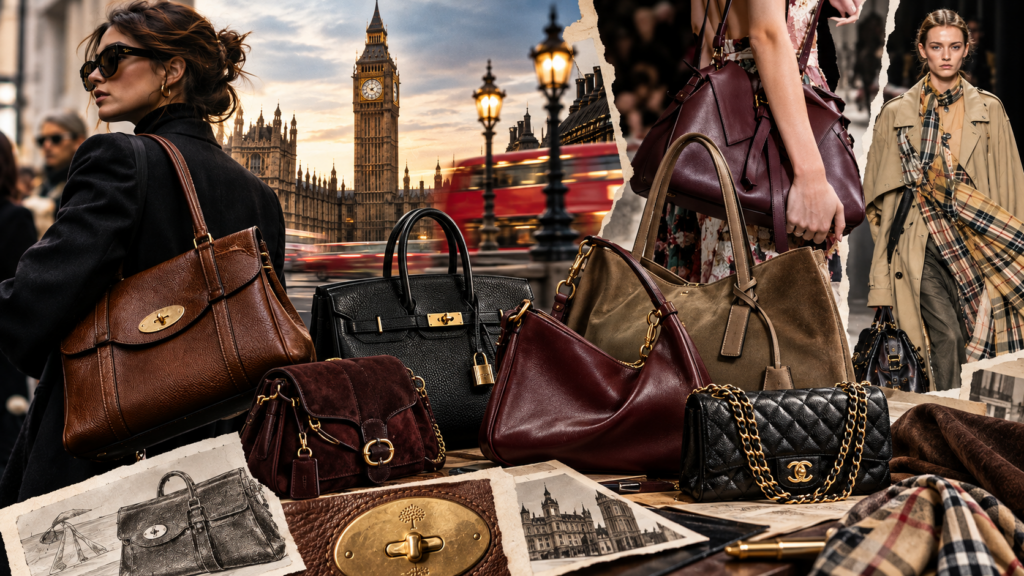
London Fashion Week itself felt unusually confident this season. McQueen returned to the official London schedule, Burberry closed proceedings under Daniel Lee, and Christopher Kane made one of the most closely watched returns of the week with his first collection for Mulberry. Vogue described the season as a renewed moment for London, with designers balancing creativity with increasingly commercial, wearable clothes.
For somebody obsessed with handbags, however, Mulberry is where I want to begin.
Christopher Kane becoming creative director of Mulberry was already fascinating.
Seeing what he actually did with it was more interesting still. Rather than pretending Mulberry’s history didn’t exist, Kane went straight into it.
The unmistakable notched shape of the Bayswater flap became almost a piece of design language in its own right. It appeared translated into clothes, collars, hems and leatherwork. At the same time, Kane introduced new bag shapes called the Axe and the Chop, one even appearing harnessed as a backpack.
And that tells us something. This isn’t a designer desperately trying to erase everything that came before him, it is somebody saying: there is value in the archive — now what can I do with it?
And you all know that, I love that.
Because the Bayswater doesn’t need rehabilitating as a good handbag. It was always a good handbag. What fashion occasionally needs reminding of is that good and currently hyped aren’t the same thing.
In fact, the timing couldn’t be better. Interest in the Bayswater had already been strengthening before the show. Earlier this year, Mulberry released 55 unique archive-derived Bayswaters for its 55th anniversary; British Vogue reported that they sold out in under ten minutes.
And then came Fashion Week.
The Bayswater wasn’t merely on the runway story. It was appearing on the streets around the shows too, with British Vogue noting the renewed visibility of a particular Mulberry heritage style among attendees. That is where my reseller ears prick up, not because I’m suggesting everybody rushes out today and buys ten Bayswaters.
Please don’t.
But because this is exactly how archive cycles become interesting.
A creative director starts referencing a house code, fashion editors begin talking about it again, the original bags reappear in street style and suddenly consumers remember them.
Then somebody looks at the current price of the new version and thinks: “Hang on. What does the original cost?”
And suddenly the archive gets very interesting indeed.
There was another idea running quietly through London that I think is even bigger.
Perfection is beginning to look slightly unfashionable.
Daniel Lee’s Burberry collection deliberately played with rumple, tarnish and imperfection. He told Vogue that he liked things not feeling perfect, cooler and younger rather than pristine and overly polished.
Now take that idea away from clothing and put it beside what’s happening in handbags.
Worn leather, softened corners, suede with movement in it. An old Bayswater that has relaxed beautifully. A Balenciaga City that doesn’t stand up perfectly anymore. A vintage tote that’s picked up the odd mark but has glorious leather.
Those things suddenly make sense, and this is precisely why I think the obsession with condition needs a little nuance in the preloved market. There is an enormous difference between damaged and lived-in.
One reduces desirability, the other can actually create character.
Fashion appears increasingly comfortable with that distinction.
There’s a fabulous little detail in Kane’s Mulberry debut that speaks to something much bigger.
He took that distinctive Bayswater flap shape and used it almost as a graphic signature. Kane described it as their way of creating a logo without actually writing the brand name everywhere.
That fascinates me, because it comes back to something we’ve already explored in the Design Language series.
The strongest houses don’t necessarily need you to read their logo. You know the object from ten paces because of its shape, closure, hardware, proportion or construction. Think about it, a Kelly, a Chanel Classic Flap, a Fendi Baguette, a Lady Dior, a Bayswater. You could remove every written logo and most handbag people would still know exactly what they were looking at.
That, to me, is real design power.
One of the broader handbag movements surrounding this season is something I’ve been banging on about for months:
Fashion has rediscovered the usefulness of a handbag.
British Vogue’s current assessment of the new wave of It-bags is telling. After the strong revival cycle around pieces such as the Celine Phantom, Balenciaga City and Chloé Paddington, its editors see the newer proposition as more grounded in bags that actually accommodate everyday life.
Thank goodness.
Because somewhere along the way luxury convinced us that a £4,000 bag capable of holding one AirPod and a Tic Tac was entirely reasonable.
I love a mini bag, I own them, I sell them. But the pendulum was always going to swing, we are seeing shoulders again, top handles, soft leather, totes, larger proportions.
Bags that don’t require you to conduct a military packing operation before leaving the house and importantly, London wasn’t presenting that practicality as boring. Quite the opposite.
Utility itself is becoming part of the luxury.
This is also why I always look at what people attending Fashion Week are carrying. A runway shows us where a designer wants to take us and the pavement tells us what fashion people actually bothered to bring with them.
London’s SS27 street style included heritage bags alongside modern cult pieces, including Balenciaga’s City, while Vogue specifically picked up on Mulberry’s renewed presence. And I find that far more interesting than everybody simply carrying whichever bag had been gifted that morning.
When older silhouettes begin appearing naturally in outfits again, something is happening. Sometimes the preloved market notices before retail does.
This is where I think we make the Archive Journal useful rather than simply observational. I wouldn’t tell anybody to speculate on handbags, this isn’t the FT with turnlocks.
But if I were browsing preloved over the next few months, these are the characteristics that would make me stop scrolling:
And perhaps most importantly: I’d buy the great example, not simply the cheapest example.
We’ve talked about that before. A tired bag doesn’t magically become archival because it is twenty years old, condition, authenticity, provenance, leather, hardware and desirability still matter.
The clever purchase is where archive relevance and quality meet.
London Fashion Week left me thinking that the handbag market is becoming more sophisticated.
For several years, luxury has been extraordinarily good at making us chase the new. New launch, new creative director, new colour, new viral bag.
But fashion is beginning to realise something the best collectors have always known, newness and desirability aren’t the same thing.
Christopher Kane walking into Mulberry and immediately finding inspiration in the Bayswater isn’t nostalgia for nostalgia’s sake, it’s recognition that great design leaves clues.
Daniel Lee allowing Burberry to look a little rumpled isn’t luxury losing its polish, it’s luxury becoming comfortable enough not to look untouched.
And seeing heritage bags walking around London Fashion Week alongside brand-new collections tells me the same thing. The archive isn’t sitting behind fashion anymore, it’s becoming part of the conversation about where fashion goes next.
And for Élan Archive? I can’t think of a more exciting place to be.
Keep the passion, enjoy the journey.
Tony
Founder, Élan Archive