
What’s Next? My Six Predictions for the Next Wave of Bags – Autumn/Winter 26
There is a question I get asked constantly. What’s going to be the next It bag? And increasingly, I think
There is a question I get asked constantly. What’s going to be the next It bag? And increasingly, I think
A Founder’s Reflection by Tony Hookings-Skinner There is a phrase I hear increasingly often when people talk about counterfeit designer
Why the smallest details can say more about a luxury bag than the biggest logo There are certain things I
More luxury guides coming soon!
From the brilliance of Karl Lagerfeld, we gained the Chanel double C, from Emil Hermes the iconic Hermès H and the gorgeous and unmistakable red sole of a Louboutin from visionary Christian Louboutin.
Then there is Louis Vuitton Monogram, you can see a tiny section of that brown canvas from the other side of a railway platform and you know exactly what it is. You don’t need to know fashion, you don’t even need to know the name of the bag and you don’t need to know what season it came from or who designed it.
You just know Vuitton.
And perhaps that is why I find what Louis Vuitton is doing right now so interesting, because fashion has spent the past few years becoming quieter. Logos have disappeared, bags have become softer and the branding has become more discreet. We have entered the world of if you know, you know luxury, beautiful leather, muted colours, relaxed shapes and pieces that sometimes give almost no indication at all of which House created them.
And yet Louis Vuitton owns one of the loudest, most recognisable visual signatures in fashion, so what do you do with that? Apparently, you teach it to whisper.
There couldn’t really be a better moment to talk about this.
2026 marks 130 years of the Louis Vuitton Monogram, and Vuitton is using the anniversary not simply to celebrate a pattern, but to explore what that pattern can become. The House has introduced anniversary capsules including Monogram Origine, VVN, Time Trunk and Monogram Emblème, each interpreting the signature through different materials and different parts of Vuitton’s heritage.
And I think that distinction matters.
Because we sometimes talk about Monogram as though it is simply a logo print, it isn’t, it has become a design language. The LV initials, flowers and quatrefoils together have accumulated 130 years of cultural recognition. They have appeared on trunks, handbags, luggage, clothes, accessories and collaborations. They have been copied endlessly, parodied endlessly and reinvented endlessly.
Very few brands possess something that recognisable, which is why abandoning it in the age of quiet luxury would make absolutely no sense. Instead, Vuitton is playing with the volume.
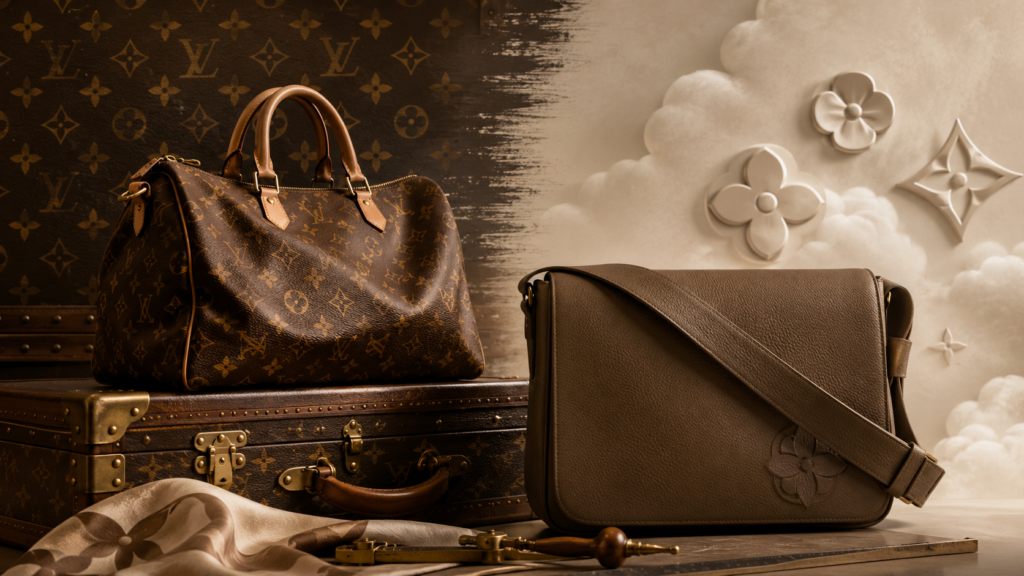
One of the most interesting developments for me is Monogram Emblème. Rather than simply putting the familiar brown coated canvas onto another bag, Vuitton has taken the motif into a softer, more elevated world of material and detailing.
For Pre-Fall 2026, the House is using the new Monogram Emblème across reworked bags including the Speedy Soft 30, alongside pieces such as the Neverfull, Multipass and other relaxed silhouettes. Vuitton itself describes the collection through bold volumes, lightweight jacquard fabrics and reimagined handbags in the new Emblème print.
And there is something very current about that.
The Monogram hasn’t gone anywhere,but it doesn’t feel quite so rigid, quite so obvious. quite so look at me. It has texture, Depth and a beautiful almost languid softness. You still recognise Vuitton immediately, but the recognition arrives differently.
And that feels completely in step with where bags are heading.
I have written before in the Archive Journal about the return of larger, softer, more relaxed bags.
We are moving away from that period where everything needed to be tiny, structured and almost architectural. Bags are beginning to look like they are actually designed to be carried again, filled, used and most crucially loved not just for “who” they are, but for how they complement the users need to really carry their life with them.
Allowed to collapse a little.
So seeing Vuitton push the Speedy Soft 30 feels significant to me. The Speedy is one of those designs almost everybody knows, even if they couldn’t necessarily name it, but softening it changes its character. Suddenly an icon that we associate with a very particular silhouette feels much more relaxed, and that’s something I keep noticing across luxury generally, structure isn’t disappearing, but there is a new appreciation for movement.
A new and exciting move towards bags that mould around the person carrying them rather than sitting perfectly on the arm, luxury is loosening its tie.
And Vuitton appears very happy to loosen it too.
This is perhaps where my argument gets even more interesting, because Vuitton is also exploring the other extreme.
The Low Key family strips things right back, soft leather. Minimal exterior branding, relaxed shapes and hardware doing much of the design work rather than a repeated logo.
It is Vuitton entering territory traditionally associated with quieter, less obviously branded luxury, and yet I don’t think it feels like Vuitton trying to become somebody else. I think it demonstrates something far more confident.
Louis Vuitton no longer needs Monogram on every square inch of a bag for you to understand what Louis Vuitton represents.
The House can move between obvious branding and almost none at all, that freedom is incredibly powerful, because the Low Key customer and the traditional Monogram customer may actually be the same person on different days.
I certainly understand that.
Sometimes I want something beautifully understated, sometimes I want a bag that announces exactly what it is from twenty paces. Isnt this the exact reason we, as collectors select a variety of different brands, silhouettes, leathers and sizes in our collections?
Fashion would be terribly dull if we had to choose one personality and stick to it.
Perhaps my favourite expression of this idea is Monogram Cloud.
For Spring-Summer 2026, Vuitton has taken its most recognisable motif and quite literally softened it into something dreamier and more atmospheric, appearing across ready-to-wear in subtle seasonal colourways. There is something wonderfully symbolic about that, you haven’t removed the Monogram, you’ve blurred it. It’s still there, It just floats.
And this is where I think Vuitton is showing a very good understanding of the current luxury customer.
People haven’t necessarily stopped wanting recognisable luxury, they simply want different levels of recognisability. Some days you want the logo, and on another day you might want somebody to notice the bag only when they’re standing next to you. And we all love that moment, because we love our trusted brands, when someone who knows Vuitton recognises something everyone else completely misses.
That’s a much more sophisticated conversation than simply declaring that logos are either “in” or “out”.
And thank goodness for that.
Because at precisely the same moment that Vuitton is softening, muting and refining Monogram, it is also celebrating some of its most joyful and exuberant interpretations. The return of Louis Vuitton x Takashi Murakami and Monogram Multicolore is the perfect example.
The House has brought back that explosion of colour across the familiar pattern, which is about as far removed from anonymous quiet luxury as it is possible to get, and I love the contradiction. On one side, we have The Low Key with its buttery soft leather, minimal branding, giving subtlety and whispering luxury.
On the other we have Murakami, colour, monogram and absolutely unmistakable Vuitton. Neither cancels the other out. Instead, they suggest that perhaps luxury has finally stopped trying to tell us there is only one correct way to dress.
For a while, the conversation around quiet luxury became almost moralistic. Visible logos were supposedly passé, understatement was sophisticated and the quieter the bag, the better the taste.
I never really bought into that, great design can whisper, great design can also shout. The important thing is whether there is enough design language behind it to make either feel authentic, and Vuitton has that in abundance.
In fact, I would argue that the rise of quiet luxury may actually have made the Monogram more valuable, because when every bag becomes beautiful brown leather, when every silhouette becomes softly slouchy and when every logo disappears… Something strange begins to happen.
Everything starts looking remarkably similar.
And suddenly owning a visual language that nobody can mistake for anybody else’s becomes an extraordinary competitive advantage.
This is something I have become increasingly interested in since starting Élan Archive. I spend my life looking at bags, buying them, selling them, researching them, handling them, and of course anyone who knows me knows, incessantly talking about them.
And the more time I spend around luxury, the more fascinated I become by the little signals that tell you what you’re looking at. Sometimes that recognition is incredibly subtle, a piece of hardware, a stitch, a proportion or a particular handle. Another collector notices it immediately while somebody else walks straight past.
But Louis Vuitton Monogram operates differently.
It belongs to that incredibly small category of luxury codes that has escaped fashion and entered popular culture. There are bags I could carry that I would need to explain, there are bags another collector would immediately recognise and then, there is Louis Vuitton Monogram.
Everybody knows it.
That level of recognition takes generations to build.
What I particularly like about Vuitton’s 130th anniversary is that the House isn’t simply reproducing the past.
Monogram Origine looks backwards to heritage, VVN (Vache végétale Naturelle) explores natural vegetable-tanned leather and Time Trunk goes directly into Vuitton’s trunkmaking history. Monogram Emblème takes the signature somewhere softer and more contemporary, past and present are sitting together.
And that, for me, is exactly what a successful heritage house should be doing, protect the codes, understand why people love them, but never become frightened of changing the way those codes are expressed.
Because heritage without evolution eventually becomes nostalgia, and nostalgia alone doesn’t move fashion forward.
I’m not actually sure it ever left, that’s the point. Trends come and go around it, minimalism arrives, logomania returns, quiet luxury takes over and vintage becomes fashionable again.
And somewhere through all of it sits that LV canvas, sometimes incredibly fashionable, sometimes declared unfashionable, sometimes everywhere and sometimes rediscovered. But always recognisable.
And now Vuitton seems to understand that it doesn’t have to choose between quiet luxury and iconic branding, it can have both. It can give us leather bags that barely whisper their identity, it can turn Monogram into clouds, Iit can weave it into softer materials or it can dig into 130 years of trunkmaking history.
And then, when it feels like it, it can cover a Speedy in rainbow Murakami Monogram and remind everybody exactly who it is.
And perhaps that is what true confidence in a brand identity looks like, not protecting an icon behind glass, but knowing it is strong enough to survive being constantly reinvented.
The Louis Vuitton Monogram doesn’t need to shout anymore.
We already know its voice.
The more I build Élan Archive, the more interested I become not simply in which bags are desirable, but why certain pieces remain desirable decade after decade. And increasingly I think it comes down to identity.
A great bag can be beautiful, an icon has to be recognisable and Louis Vuitton managed to create something 130 years ago that still communicates across generations, genders, countries and completely different levels of fashion knowledge.
That isn’t simply good branding, That’s design history. right there!
And right now, watching Vuitton take that incredibly familiar language and make it softer, looser and quieter without ever losing itself might be one of the most interesting evolutions happening in luxury.
So I’m curious.
Does the quieter Vuitton appeal to you?
Or, if you’re buying Louis Vuitton, do you want the Monogram to be unmistakably Louis Vuitton?
Because I suspect the answer to that question says quite a lot about where luxury goes next.
Keep the passion. Enjoy the journey.
Tony
Founder, Élan Archive