There was a time when Gucci was impossible to ignore.
It wasn’t simply a fashion house. It was the fashion house.
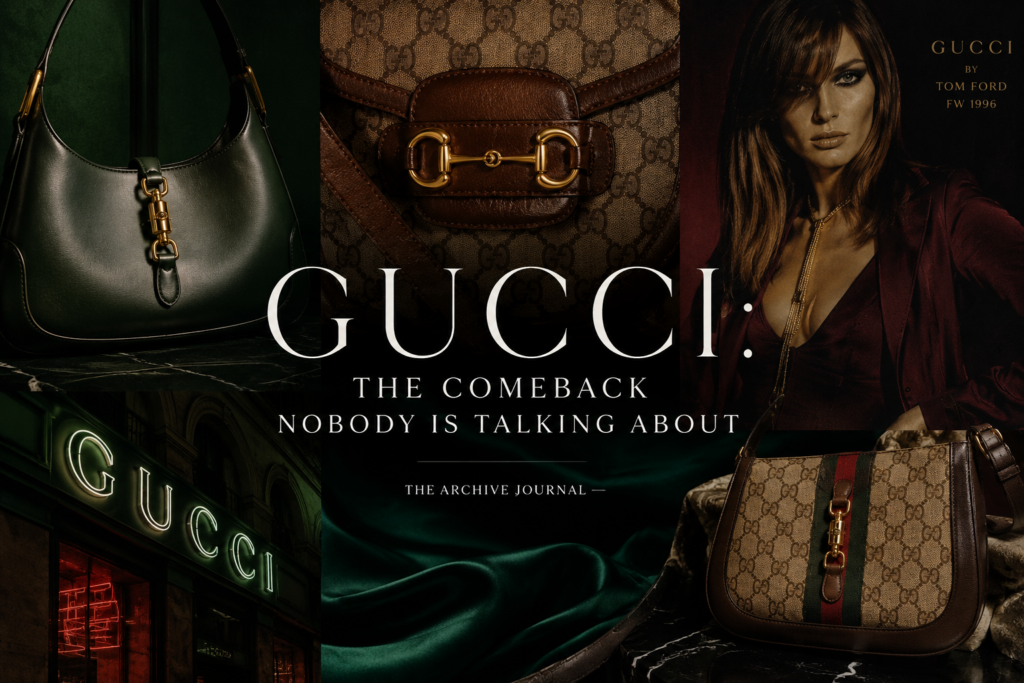
Under the creative direction of Tom Ford and later Alessandro Michele, Gucci repeatedly defined the mood of an era. It was provocative, glamorous, maximalist, sexy, eccentric and unapologetically confident.
Then something interesting happened.
Fashion moved on.
The conversation shifted toward quiet luxury. Toward discretion. Toward brands whose appeal lay not in visibility but in subtlety.
Suddenly, the industry that couldn’t stop talking about Gucci stopped talking about Gucci altogether.
Or so it seemed.
Because beneath the surface, something fascinating is happening.
And for collectors, it may be creating one of the most interesting opportunities in luxury today.
The House That Reinvented Itself Again and Again
Few luxury brands have transformed themselves as successfully as Gucci.
The Tom Ford years gave us a vision of Gucci that was sleek, seductive and impossibly glamorous.
Then came Alessandro Michele.
Almost overnight, Gucci became fashion’s cultural epicentre.
Vintage references collided with maximalism. The house embraced colour, embellishment, eccentricity and self-expression in a way that felt entirely fresh.
For a period, Gucci wasn’t simply selling handbags.
It was selling imagination.
And consumers couldn’t get enough.
When Success Becomes Saturation
Luxury’s greatest challenge is often its own popularity.
The more successful a brand becomes, the harder it becomes to maintain exclusivity.
Over time, Gucci’s extraordinary visibility began to work against it.
The market became saturated.
The logos became familiar.
The novelty gradually faded.
At the same moment, consumers began gravitating toward something different.
Less obvious luxury.
More restraint.
More permanence.
The Rise of Quiet Luxury
The luxury landscape of today looks very different from the one Gucci dominated.
Brands like Hermès and The Row became symbols of a new approach to luxury.
One defined by:
- Craftsmanship
- Scarcity
- Understatement
- Longevity
The shift wasn’t about spending less.
It was about signalling less.
And suddenly Gucci’s maximalist energy felt out of sync with the prevailing mood.
But fashion is cyclical.
And cycles have a habit of returning.
Why Gucci Is Suddenly Interesting Again
Today, Gucci finds itself in a unique position.
It is no longer the hottest brand.
It is no longer the most discussed.
And that’s precisely why collectors are paying attention.
The best opportunities in fashion rarely emerge when everyone is looking.
They emerge when attention moves elsewhere.
This is often where value is found.
And increasingly, collectors are beginning to revisit Gucci’s archives.
The Bags I’d Be Buying Today
Not every Gucci bag is created equal.
But certain pieces stand apart.
These are the bags that continue to feel relevant regardless of trend cycles.
The Jackie
If there is one Gucci bag that perfectly encapsulates timeless elegance, it is the Gucci Jackie.
Originally associated with Jacqueline Kennedy Onassis, the Jackie has survived decades of fashion change without losing its appeal.
It is:
- Sophisticated
- Understated
- Instantly recognisable
Most importantly, it feels just as relevant today as it did twenty years ago.
Few bags can claim that.
The Horsebit 1955
If the Jackie is Gucci’s icon, the Horsebit may be its strongest all-rounder.
The signature hardware immediately links the bag to the house’s equestrian heritage.
Yet the overall design remains clean, elegant and wearable.
For collectors seeking a safe long-term Gucci purchase, it is difficult to overlook.
Vintage Tom Ford Gucci
This is where things become particularly interesting.
The Tom Ford era has begun to attract renewed attention from collectors.
The appeal is obvious.
These pieces represent a specific moment in fashion history.
A period where Gucci was arguably the most influential luxury brand in the world.
As younger collectors continue discovering late 90s and early 2000s fashion, demand is only likely to increase.
The Y2K Revival
Few trends have returned with as much force as Y2K.
And Gucci was one of the defining brands of that era.
From shoulder bags and horsebit details to archive monogram pieces, collectors are increasingly looking backwards.
The irony of fashion is that yesterday’s overlooked piece often becomes tomorrow’s sought-after treasure.
A New Creative Chapter
The appointment of Demna signals another major turning point for Gucci.
Love him or hate him, Demna is one of fashion’s most influential figures.
His arrival suggests Gucci is unlikely to play it safe.
And while nobody knows exactly what the next chapter looks like, history tells us one thing:
Gucci rarely stays quiet for long.
The Élan Perspective
At Élan Archive, we’re watching Gucci closely.
Not because it’s currently dominating the conversation.
But because the most interesting luxury opportunities often emerge during moments of transition.
Today, Gucci offers something increasingly rare:
A globally recognised luxury house with significant heritage, iconic bags, and pockets of genuine value still waiting to be discovered.
The Jackie.
The Horsebit.
The Tom Ford years.
The early 2000s archive pieces.
These aren’t simply fashion purchases.
They’re pieces of fashion history.
And history has a habit of becoming desirable again.
Looking Ahead
Luxury is often obsessed with what’s next.
Collectors understand the importance of looking backwards.
As Gucci enters another new era, the smartest buyers may already be revisiting the pieces that built its legacy.
Because while fashion moves quickly, great design never truly disappears.
Sometimes it simply waits for the world to notice it again.
Explore The Archive
Discover a curated selection of authenticated luxury pieces from the world’s most enduring houses.
For early access to new arrivals, join the Members Archive — where the most sought-after pieces are often secured before public release.
Keep the passion. Enjoy the journey
By Tony Hookings-Skinner, founder of Elan Archive