The Fake Problem : Why Counterfeit Luxury Costs More Than You Think
A Founder’s Reflection by Tony Hookings-Skinner There is a phrase I hear increasingly often when people talk about counterfeit designer

A Founder’s Reflection by Tony Hookings-Skinner There is a phrase I hear increasingly often when people talk about counterfeit designer
There are some things in fashion that need absolutely no introduction. From the brilliance of Karl Lagerfeld, we gained the
Why the smallest details can say more about a luxury bag than the biggest logo There are certain things I
There is a question I get asked constantly.
What’s going to be the next It bag?
And increasingly, I think we’re asking the wrong question. Because what interests me heading into Autumn/Winter 2026 isn’t which single bag is going to dominate Instagram for six months. It’s something much bigger.
What are we going to want from our bags next? Because that is changing.
For several years luxury has been caught between two competing ideas. On one side, the highly recognisable It bag, the bag that announces itself before you’ve even noticed the person carrying it. On the other, quiet luxury: minimal branding, restrained design and a sort of studied anonymity, AW26 feels different. I’m seeing craftsmanship becoming visible again, texture becoming important, proportion changing and bags becoming useful again. Designers are revisiting archives, but rather than simply reproducing old successes, they are manipulating them, enlarging them, softening them, collapsing them and developing new construction techniques.
And perhaps most importantly, I think we are becoming less interested in owning the right bag and more interested in owning a really good bag.
So these aren’t simply my six It bags, these are my six predictions for where handbag design is going next.
My first prediction is probably the easiest one for anyone who has followed me for a while, we are not going back to tiny bags. Yes, there will always be beautiful evening bags and miniatures, but the direction of travel for everyday luxury is bigger, not necessarily enormous, but just useful.
AW26 runways are full of what Vogue has called the “super shoulder bag”, shoulder bags enlarged enough to carry far more than lipstick and a phone, and some roomy enough for a laptop. Chanel, Miu Miu, Chloé and Balenciaga are all part of that movement, and I think this shift matters far beyond fashion.
For years we were almost trained to accept that our expensive handbag didn’t actually have to carry anything, now functionality has become luxurious again.
That is precisely why something like the Coach Empire has resonated so strongly. It is substantial, it has presence, it uses proper leather, it develops character and crucially, it works in somebody’s actual life. I personally have two Empires, one in Merlot and one in suede and I wouldn’t be without them.

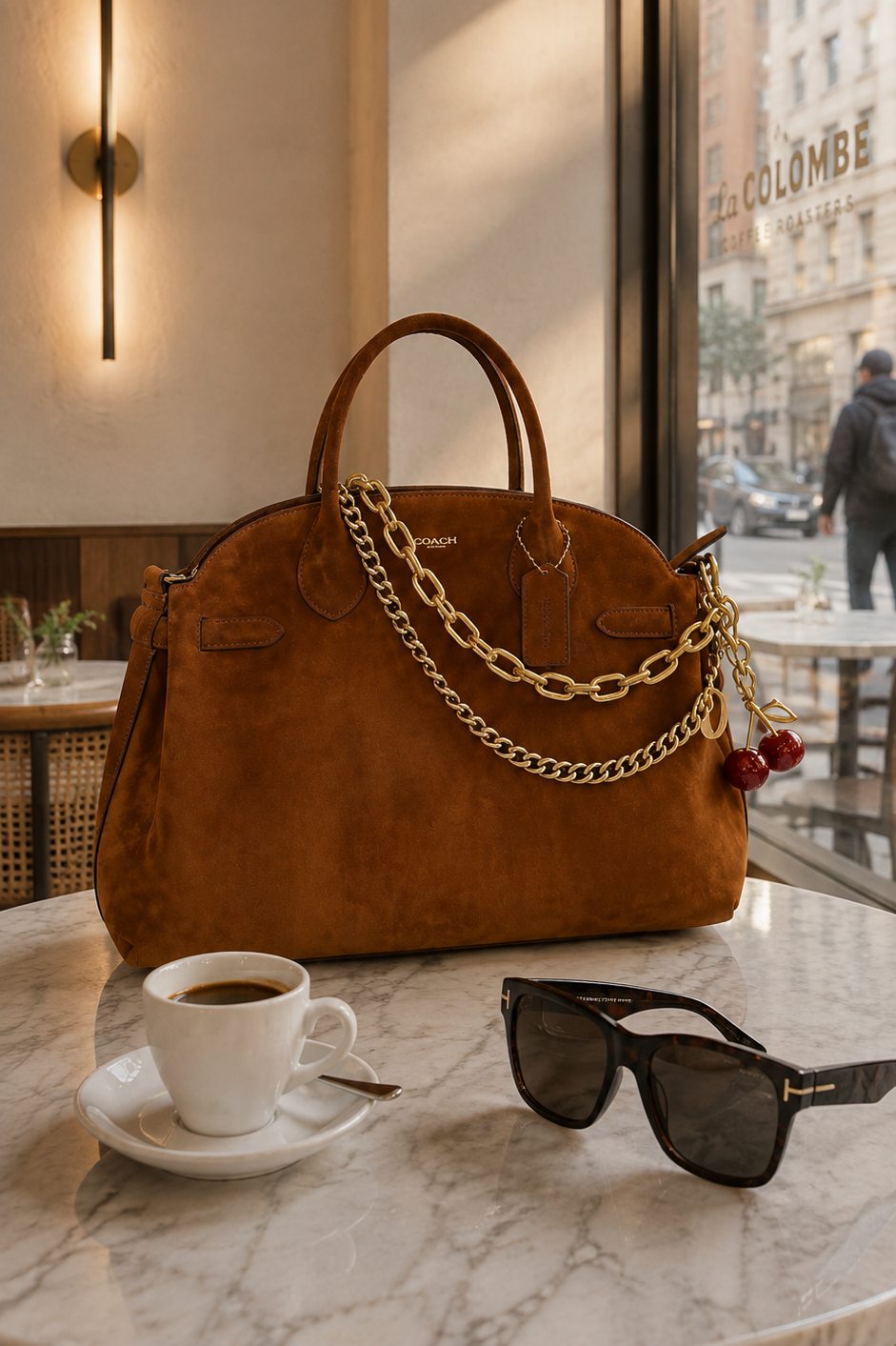
At the very top end Chanel is playing with dramatically enlarged silhouettes. At a completely different price point, Coach understands exactly the same emotional pull and this is why I always say trend doesn’t have to mean expensive. You can participate in a movement through proportion, fabrication and construction rather than through a logo.
What I’d watch: Chanel oversized shoulder bags, Coach Empire and Soft Empire, larger Bottega silhouettes, vintage Céline, older Mulberry Bayswaters, generously proportioned suede totes and beautifully made unbranded leather carryalls.
Tony prediction:
By winter, the coolest bag in the room may also be the one somebody can actually put their iPad in.
This is where AW26 becomes really interesting, because while bags are becoming larger and more relaxed, proper structure is returning at exactly the same time. We are seeing the return of Doctor bags, Bowling bags, top handles and east-west cases.
But they’re not the rigid, ultra-formal bags we associate with traditional ladylike dressing, they look softer, a little lived in, sometimes even deliberately undone.
The bowling or doctor-bag shape has been building throughout 2026, with houses including Miu Miu, The Row and Balenciaga embracing the arched top handle and wide opening.
Loewe takes it somewhere even more interesting, its Amazona has been manipulated into shapes that feel simultaneously archival and entirely contemporary, retaining the skill required to construct a proper leather bag while deliberately relaxing the finish.


And that distinction matters, craftsmanship does not always mean rigidity.
In fact, making beautifully soft leather hold exactly the right amount of shape can require considerably more understanding of material than simply reinforcing everything until it becomes solid. This is one area where I think contemporary brands can do exceptionally well.
A beautiful bowling bag from a £500–£900 brand with excellent leather and restrained hardware may feel considerably more relevant than a £3,000 bag whose entire proposition is its logo.
What I’d watch: Loewe Amazona, Miu Miu Beau and Vivant, Prada bowling shapes, DeMellier, Coach kisslock and barrel silhouettes.
Tony prediction:
The bag everyone dismissed as “a bit old fashioned” five years ago is about to become incredibly chic.
This could be one of the most important changes. For a long time branding did the work, monogram told you Louis Vuitton, Quilting told you Chanel and that iconic set of sangles told you Hermès. But when logos become quieter, designers need another way to make a bag visually interesting and texture is starting to do that job.
Croc-embossed leather has appeared extensively for AW26 at Chanel, Gucci, Prada, Bottega Veneta and Celine but that doesn’t mean everyone suddenly needs an exotic-looking bag.
It’s about the surface, gloss against matte leather, deep embossing, suede, woven leather, calfhair, the grain, even deliberately aged finishes. This is where craftsmanship becomes incredibly visible, a beautiful skin doesn’t need a giant logo slapped across it.
You notice how it has been selected, how the pattern lines up, how the edges have been finished, how the leather folds around the base even how the hardware meets the hide. That, for me, is far more interesting.
And again, there is a huge budget range here. At one end, Bottega’s intrecciato is effectively texture as branding. While at the other end of the scale, there are incredibly well-made contemporary bags using suede, embossed leather and woven construction that communicate quality without needing a household name stamped across them.
The AW26 colours I’d watch: Chocolate. Tobacco. Oxblood. Merlot. Olive. Cognac. Black with shine.
Not because beige has disappeared, but because rich colour makes material look even better. Deep chocolate suede could become one of the defining handbag looks of this autumn, and darker merlot shades are already being singled out as an emerging seasonal direction.
Tony prediction:
The question changes from “What brand is that?” to “What leather is that?”
And frankly, I love that.
Yes, east-west is already here, but I don’t think we’ve seen its final form.
Alaïa’s Le Teckel helped propel the long, narrow silhouette back into fashion, and AW26 sees versions appearing across Prada and elsewhere. Vogue specifically identifies the east-west as one of the season’s key directions. My prediction is that the silhouette now grows up, the first wave was narrow, sleek and often quite dainty.
The next wave becomes more useful, slightly deeper, perhaps longer, possibly top-handled, maybe softly structured rather than completely rigid, and suddenly a fashion trend becomes a proper bag.
That’s when I become interested, because a silhouette has longevity when designers can reinterpret it rather than simply repeat it.
Prada’s AW26 use of elongated top handles is particularly interesting because it demonstrates how proportion alone can make a classic leather bag feel modern. This is also a trend where you absolutely do not have to spend thousands. There are excellent east-west bags appearing throughout contemporary brands, and the preloved market is full of early-2000s bowling bags and elongated shoulder bags whose proportions suddenly look incredibly current again.
Tony prediction:
Stop searching only for “new season”.
Start searching preloved for bowling bag, barrel bag, elongated shoulder bag and doctor bag.
There are bargains hiding in plain sight.
This is my slightly more controversial prediction.
I think the obsession with pristine is beginning to weaken, not damaged, not neglected but Lived in. There is a massive difference, some bags become better through use. Barenia, Vegetable-tanned leather, beautiful calfskin and suede.
Take for instance, Balenciaga’s soft leathers, vintage Bottega or Mulberry’s older natural leathers.
A great leather bag should tell you something after ten years that it couldn’t tell you after ten days.
We are already seeing intentionally undone and softened construction coming directly from luxury houses. Loewe’s recent Amazona iterations deliberately play with relaxed form, while slouchy bags are being highlighted as one of Autumn 2026’s strongest broader movements.
Even Chanel under Matthieu Blazy has been actively challenging the idea that luxury must look immaculate, from earlier crushed-effect interpretations of the 2.55 to the much more experimental proportions now coming through the house. Philosophically, I find that fascinating, because luxury has spent years teaching consumers to fear using the thing they just spent thousands buying.
Corner wear, creasing, patina and softening, perhaps we’re finally remembering that those things can also be evidence of exceptional material ageing exactly as it was supposed to.
This could have a huge impact on the preloved market. Suddenly a beautifully softened 15-year-old bag isn’t the inferior alternative to something brand new, it might be the cooler one.
Tony prediction:
One of the biggest luxury signals of the next few years may simply be:
“I’ve actually used it.”
This is probably my favourite prediction, because fashion loves pretending it has invented something new when, quite often, somebody has simply opened an archive.
We’re already seeing designers return to historic silhouettes and reinterpret them for a new generation. Celine has revisited the Phantom, Balenciaga continues to evolve Le City, Loewe has reworked the Amazona, and Chanel is playing with some of its most recognisable handbag codes in ways that feel completely fresh.
That is exactly why I’m watching the 1990s and 2000s preloved market so closely.
And no, it isn’t simply because “Y2K is back”. That’s far too easy. What interests me are the bags whose proportions, construction and materials suddenly make complete sense again. Bags that perhaps looked oversized, over-designed or simply unfashionable five years ago, but now sit perfectly alongside what we’re beginning to see on the runway.
Think about the Chloé Paddington, the Fendi Spy, the Saint Laurent Mombasa or those beautifully slouchy early Balenciaga City bags. There was something incredibly confident about handbag design during that period. The silhouettes had personality, the hardware was often complicated, and some of the leathers were phenomenal — soft, tactile and designed to develop character rather than remain pristine forever.
And that is where I think the real opportunity sits.
As designers return to those shapes and ideas for new collections, the original bags suddenly start to look relevant again. But while the fashion world is busy introducing the “new” version on the catwalk, the savvy consumer can still go hunting for the beautifully made original.
For me, that is where collecting becomes really exciting.
Because once everyone has decided that a particular vintage bag is desirable again, the interesting buying opportunity has usually disappeared with it. Prices rise, the best examples become harder to find and suddenly the bag you could have bought for a few hundred pounds is being described as a cult collectible.
The fun is getting there first.
It’s spotting a silhouette or a leather or a forgotten piece of design history and thinking, hang on, this suddenly looks incredibly good again — before everybody else reaches the same conclusion.
And this is exactly where I would happily spend £300 before spending £3,000. I’d much rather find an immaculate, overlooked piece from twenty years ago made from phenomenal leather and beautifully constructed than buy something mediocre simply because it arrived in stores this season.
That, for me, is what the archive should really be about. Not just looking backwards, but using the past to understand what might be coming next.
And perhaps finding tomorrow’s It bag before anyone has decided to call it one.
Tony prediction: Some of the most desirable bags of 2027 are probably sitting on Vestiaire, eBay and in vintage stores right now — and hardly anybody is searching for them.
For me, AW26 isn’t really about big bags, bowling bags, suede or croc. Those are just the visible signs of something deeper. What I think is actually happening is that we’re starting to care about the object again — not just the logo on the front of it or whether somebody on TikTok has decided it’s the bag of the moment.
I think people are becoming more interested in how a bag is made, how it feels in the hand, why a particular leather has been chosen and why the handle sits exactly where it does. We’re starting to notice whether a bag actually works in real life, whether the proportions feel considered, whether the construction is clever and whether somebody had to develop a new technique or process to make that shape possible in the first place.
And for me, that is where the luxury conversation gets really interesting again. Because the best bags have always been about more than status. They’re about design, material, proportion and the way something changes as you live with it. A really good bag shouldn’t become less beautiful the moment you start using it. In many cases, it should become better. Softer. More personal. More recognisably yours.
What I love about this shift is that you don’t need £10,000 to participate in it. Yes, you could buy Chanel or Loewe, but you could also buy Coach or DeMellier, or spend £400 on a beautifully made preloved bag that almost nobody is talking about yet. That’s the part I think gets lost too often in luxury. Price and quality are not the same thing, and a higher price tag does not automatically mean better design.
I actually think that may be the most important part of what comes next. The bags that really cut through over the next few seasons won’t just be the ones that are pushed hardest, gifted most widely or declared “the next It bag”. They’ll be the ones people pick up and immediately want to understand. The ones that feel good, work properly, are beautifully made and have something interesting going on in the design.
That’s what a great handbag has always done. It makes you curious. It makes you look twice. It makes you care about the thing itself.
And maybe, after a few years of being slightly distracted by hype, that’s exactly where we’re heading back to.
Keep the passion, enjoy the journey.
— Tony
Founder, Élan Archive | The Designer Bag Guy