
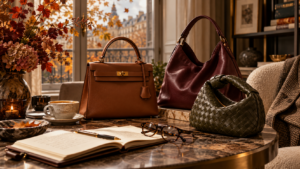
WHEN DID WE STOP BUYING THINGS WE LOVE?
An Autumn Reflection on Fashion, Value and Finding Your Own Style THE ARCHIVE JOURNAL | A FOUNDER’S PERSPECTIVESunday, 25 October
An Autumn Reflection on Fashion, Value and Finding Your Own Style THE ARCHIVE JOURNAL | A FOUNDER’S PERSPECTIVESunday, 25 October
ÉLAN ARCHIVE | SUNDAY 18 OCTOBER 2026 As billions disappear from the valuations of the world’s biggest luxury companies, something
Why the greatest handbags are recognisable without a logo, and what their silhouettes tell us about fashion, craftsmanship and the
More luxury guides coming soon!
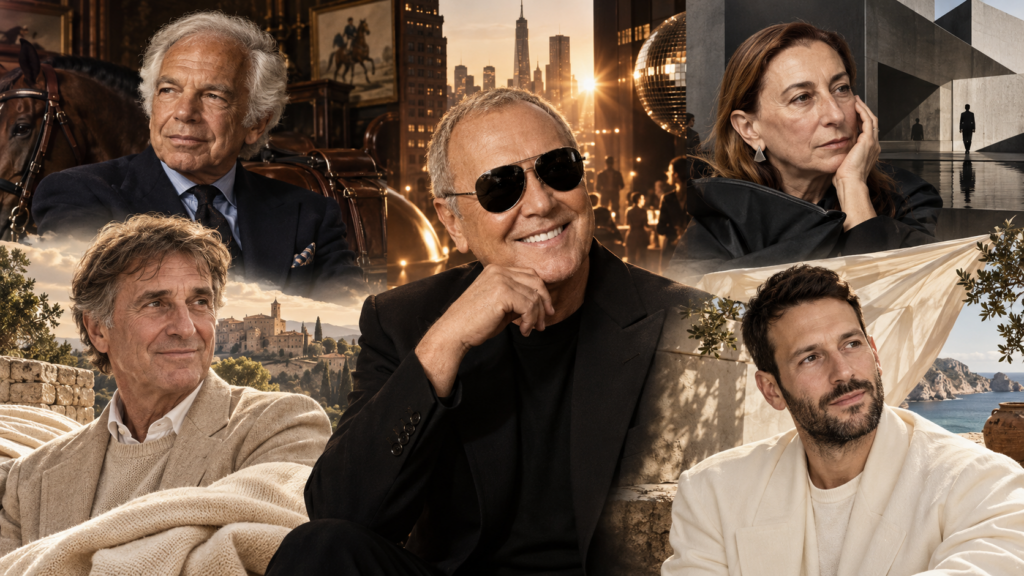
From Ralph Lauren and Prada to Michael Kors, why the people behind our favourite fashion houses deserve as much attention as the names on our bags.
By Tony Hookings-Skinner | Founder, Élan Archive
I recently watched Dylan Kelly walking and talking with Michael Kors on Instagram, and I was enthralled.
Here was a designer recalling his early working life: being eighteen, serving extraordinary women, and finding his way through a New York where fashion, music, art and nightlife collided. Jackie Kennedy. Diana Ross. Cher. Memories of Andy Warhol and Bianca Jagger.
What struck me was how easily we can overlook the person behind a name we see everywhere.
We recognise the logo. We know the handbag. We might even have an opinion about the brand before we have bothered to learn its history.
But listen to Michael Kors speak, and that familiar name becomes a person with decades of experience, an eye trained by actual customers and a lifetime spent thinking about glamour.
Accessible? Yes. Iconic? Hell yes.
And I think fashion owes him, and several other living visionaries, a little more respect.
Kors’s own label began in 1981. His education in style started earlier, including his work at the New York boutique Lothar’s. Vogue’s career timeline records him working there while studying at the Fashion Institute of Technology in 1977, then leaving college to work there full time in 1978.
That matters because selling clothes teaches you something a beautiful sketch cannot: how a person actually wants to feel in them.
You see hesitation. You hear objections. You discover that a woman can adore a dress and still need to sit down in it.
Kors has also spoken in published interviews about dining with Andy Warhol and his nights at Studio 54. The glamour in his work has a personal history behind it. He experienced that world while developing his own understanding of style.
To my eye, his great skill is translating that excitement into something wearable. The polished jacket. The ease of American sportswear. A handbag that makes an ordinary day feel a little more put together.
And there is a distinction we need to make: Michael Kors Collection, the designer’s luxury runway line, and the more accessible MICHAEL Michael Kors label occupy different positions within the same brand. He also served as creative director of Céline from 1997 to 2004, while continuing to build his own business. That chapter belongs in any serious understanding of his career.
Judging his entire career through the most widely distributed accessories is a very narrow way to assess a designer.
But the accessible bags deserve their own consideration.
Think of the Hamilton, the Selma or a Jet Set tote. For a customer saving for her first designer purchase, those pieces could make the world of fashion feel within reach. The shape, the hardware, the recognisable name: a little of that polished, jet-set confidence brought into everyday life.
I consider that an achievement.
Fashion can be strangely quick to celebrate a designer for creating desire, then become dismissive when a wider audience gets to enjoy it.
If our entire judgement changes because more people can buy the bag, we should ask what we were admiring in the first place.
Of course we can question a product’s construction, branding, distribution or price. Respect does not require us to love every collection. But criticism should be informed by the work, rather than embarrassment that somebody else owns the same logo.
A designer’s cultural importance does not disappear when their customer base expands.
Ralph Lauren founded his company in 1967 and remains its Executive Chairman and Chief Creative Officer.
What fascinates me is the consistency of the world he has built.
You can picture it before seeing a label: an equestrian portrait, a beautifully worn leather chair, denim with a tailored jacket, a country house that somehow feels familiar even if you have never set foot inside one.
My reading of Ralph Lauren is that he sells belonging. His clothes and accessories offer a way to step into an imagined life.
That is why the equestrian references in a Ralph Lauren bag feel so convincing. The leather and hardware sit within a much larger visual story. They have somewhere to belong.
There is enormous discipline in keeping that world recognisable across decades without allowing it to become a costume.
In fashion, we often mistake a dramatic change for creative ambition. Lauren reminds me that developing a clear point of view over a lifetime can be just as ambitious.
Prada complicates the founder story beautifully.
Miuccia Prada did not establish the original house. Her grandfather founded the business in 1913. But through her creative vision and her partnership with Patrizio Bertelli, she helped transform it into the modern Prada we recognise.
She remains Prada’s Co-Creative Director alongside Raf Simons, as well as Creative Director of Miu Miu.
For me, Prada’s appeal is the way it unsettles our assumptions.
Why should a luxurious object have to look conventionally precious? Why do we find one proportion elegant and another awkward? How much of our taste is instinct, and how much have we learned from the people around us?
The house’s elevation of nylon is the perfect handbag example. A practical material became an object of fashion desire. The familiar relationship between luxury and material was suddenly open to question.
I find that far more interesting than simply adding another expensive finish.
Where Kors offers an immediately understandable fantasy of glamour, Prada often makes me pause and work out why I am drawn to something.
And the partnership with Raf Simons adds another dimension to this article. A living visionary can share authorship. Collaboration can keep a house intellectually alive.
The point is that Miuccia’s perspective still participates in the conversation. Modern Prada’s history is being developed by someone who helped create it.
Brunello Cucinelli founded his business in 1978 and remains Executive Chairman and Creative Director. His story brings together cashmere, craftsmanship, the Umbrian village of Solomeo and his stated philosophy of humanistic capitalism.
The house presents work, dignity, culture and place as connected parts of its identity. Solomeo’s restoration gives that story a physical setting.
What interests me is how closely the aesthetic supports it.
To my eye, those restrained colours, tactile materials and relaxed proportions suggest a particular pace of life. The clothes invite you to imagine time to appreciate how something feels and how it was made.
There is also a question I think we should be prepared to ask: when a house makes ethics central to its appeal, its practices deserve scrutiny alongside its products. A compelling philosophy creates expectations.
That does not weaken the story. It makes it consequential.
Cucinelli demonstrates how a founder’s beliefs can give a fashion house an identity that reaches well beyond a seasonal collection.
Simon Porte Jacquemus founded his house in 2009, dedicating it to the memory of his late mother. His brand’s own account places French life, art and visual culture at its heart.
To me, its strongest images feel personal: sunlight, landscape, family, sensuality and a sense of humour.
A tiny bag such as Le Chiquito makes more sense within that world. Its exaggerated scale is part of the pleasure. It asks to be noticed, photographed and enjoyed.
I think dismissing Jacquemus as merely clever marketing misses something. Marketing is one of the ways his authorship reaches us. A location, a proportion and an image can communicate the same sensibility.
The harder question is whether that feeling survives when the spectacle is removed. Does the object still carry enough of the designer’s perspective when it is sitting on your kitchen table?
For me, that is a useful test of any fashion house. The campaign creates the invitation; the product has to sustain the relationship.
These designers offer very different reasons to care.
Lauren gives a dream a coherent setting. Kors makes glamour feel usable and accessible. Prada challenges the assumptions behind our desires. Cucinelli places a philosophy around the product. Jacquemus turns personal feeling into a recognisable visual world.
None builds alone. These are businesses sustained by designers, craftspeople, commercial teams and collaborators. Remaining creatively involved is also different from running every part of a company.
But a living author brings something particular to a house: the ability to explain, challenge and develop the ideas from which it grew.
That is what held my attention while watching Kors. I wanted to listen because there was experience behind the confidence.
And it is something I care about at Élan Archive.
I want to understand what a bag represents, why its design mattered and where it belongs in the wider story of fashion. I want my clients to feel that curiosity too, whether their budget takes them towards Michael Kors or Hermès.
Price, resale performance and cultural significance answer different questions. A bag can have modest resale value and still belong to an important fashion story.
Good fashion knowledge should make us more curious, not more snobbish.
So before dismissing a familiar name, take a moment to meet the person behind it. Listen to what they have seen. Look at what they have built.
Michael Kors has spent decades giving people a way into his idea of glamour.
That deserves respect.
Keep the passion, enjoy the journey.
Join the Members Archive at elanarchive.co.uk to receive each new Archive Journal in your inbox.